
How Amazon's Knowledge Graph Works
Product nodes, concept nodes and your Core Node: the plain-English guide to the web of relationships Amazon uses to understand and recommend your book.
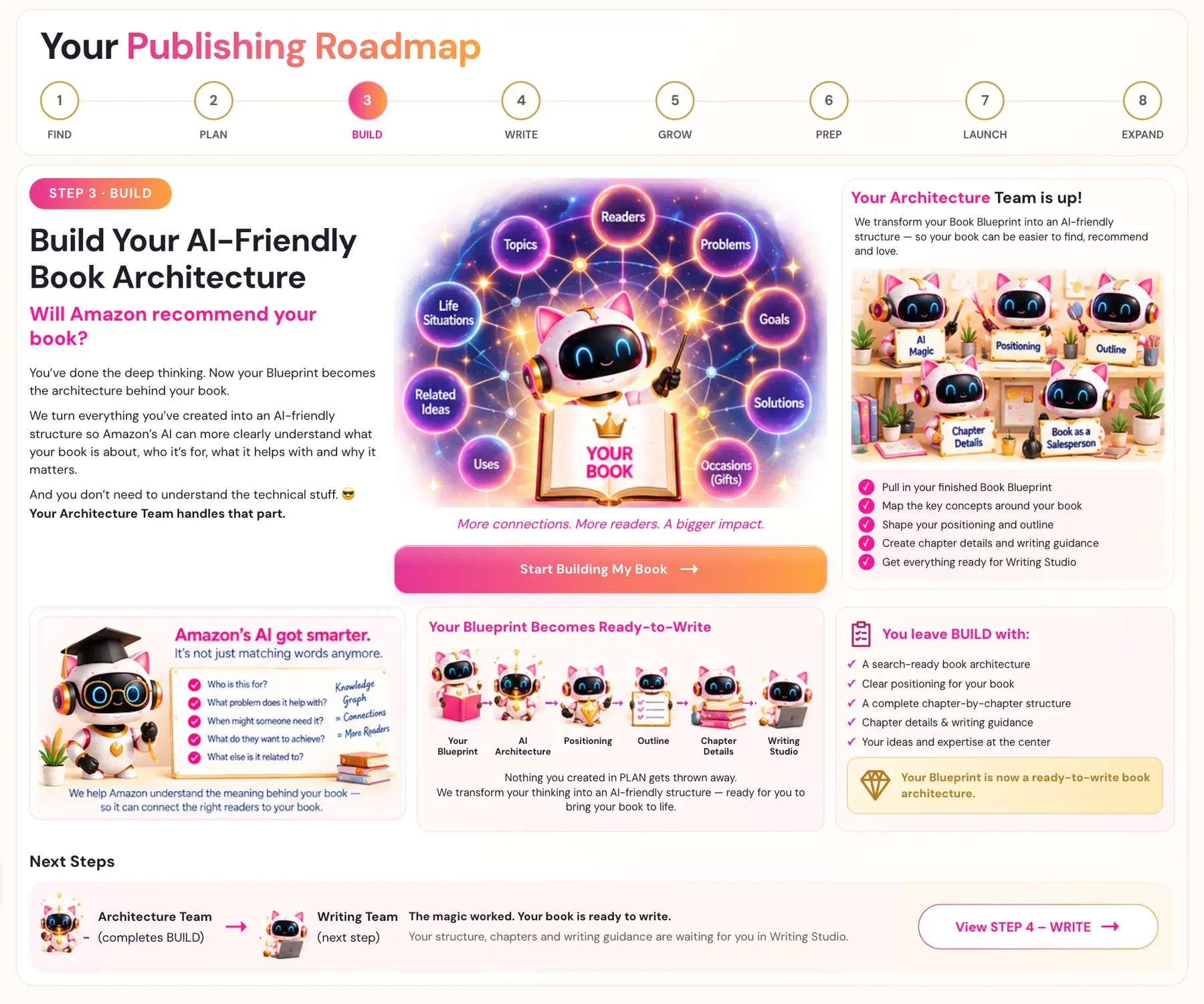
Amazon's Knowledge Graph is a web of connections between ideas. Your book plugs into that web through one main idea, your Core Node, and through the ideas around it. The clearer those connections are, the better Amazon understands your book and the more readers it shows it to.
What Are Product Nodes and Concept Nodes?
- A product node is your actual book listing, its ASIN.
- A concept node is an idea your book connects to, such as guilt relief, nervous system regulation or working mom identity.
- Your Core Node, also called your Core Entity, is the main concept node that links your book to the web. It is the one idea Amazon files your book under. Think of it as your book's address in Amazon's graph.
Amazon itself says "entity" or "node" and does not use the phrase "concept node". The course uses it because it describes exactly what Amazon measures. Amazon's own COSMO research confirms the substance.
What Are the Three Layers of an Idea?
Each idea shows up three ways, and the Knowledge Graph Generator maps all three.
- Concept node. The idea itself, as Amazon stores it. Example: Mom Guilt.
- LSI term. The phrase you write in your book. Examples: "mom guilt", "guilt spiral", "evening guilt".
- Intent string. The full question a reader types or says. Example: "why do I feel so guilty after work?"
What Is My Core Node?
For every product, Amazon looks at who it is for, what problem it solves and what change it delivers. Your Core Node puts all three into one phrase of three to five words.
Reader + Primary Gap → Transformation = Core Node
"Working Mom" + "Guilt" → "Reset" gives "Working Mom Guilt Reset". It is a phrase people search for, not your title. The last word should be the natural answer to the problem. Guilt ends in relief, release or freedom. Exhaustion ends in reset, renewal or restoration.
Why Does a Book Get Only One Core Node?
A book can connect to many ideas, but it can have only one main anchor. If it tries to own three ideas equally, the signal gets weak and Amazon cannot place it with confidence.
This is why a series works so well. Book 1 might own "Working Mom Guilt Reset" and Book 2 "Working Mom Evening Burnout Recovery". They share an audience and several concept nodes, so Amazon groups them together, and each book still owns its own territory. Three books own three ideas. That covers far more than one book trying to cover everything.
What Are Complementary Themes?
The five to seven themes you named in the Book Planner are the other concept nodes your book covers. They matter. They flow into the Knowledge Graph Generator as ticked concept nodes. A complete web usually has seven to fifteen concept nodes beyond the Core Node. For a working mom burnout book, they might be Mom Burnout, Invisible Mental Load, Evening Routine Chaos, Cortisol Spike, Nervous System Regulation, Mom Identity Loss and Permission to Rest.
What Are the 18 Connections?
They come in six groups.
- Audience. Who is the book for? Used For Audience, Used By, xIs A.
- Classification. What kind of book is it? Is A, Used As.
- Functional. What does it do? Used For Function, Used To, Capable Of.
- Context. When, where and how is it used? Used For Event, Used On, Used In Location, Used In Body.
- Interest and Desire. What does the reader want? xWant, xInterested In, Used With.
- Book Specific. Author, Series and Format.
Amazon's COSMO research documents 15 of these connections. The course adds three that Amazon tracks for books: Author, Series and Format. The "x" connections come from how people really search and buy. The others come from products bought together and product details.
Context is the group people underestimate most. The book "Breathe, Mama, Breathe" ranks fourth in its niche without matching title keywords. It names the exact moments of the day again and again: the morning ritual, school drop-off, evening bath time, bedtime. Every moment in your reader's day is another way for Amazon to find your book.
Why Is One Precise Idea Better Than Five Vague Ones?
Amazon's COSMO research shows that the system gives far more weight to the most common reason readers search than to every possible reason. The paper reports that 44 percent of search-to-purchase connections are typical, and only 9 percent of co-purchase connections are. A book that answers the most common reason will beat a book that tries to cover every angle. For each idea, ask yourself whether most buyers in your niche really want it. If it only fits a few buyers, cut it, even if it is real.
What Are Customers Say Tags and Popular Highlights?
Amazon pulls key phrases from your listing copy and matches them to concept nodes. It shows them as "Customers Say" tags. It reads your copy first, not your reviews, so good listing copy alone can create the tags. Early readers who highlight passages with your key phrases make them stronger.
How Does My Blueprint Become a Knowledge Graph?
Your Book Blueprint holds everything needed to build this web in your own words. In Step 3 · BUILD, Golden Bestseller Empire turns it into your Amazon-ready Knowledge Graph and creates your outline and chapter details from it. Only Golden Bestseller Empire offers this. Continue with How to Use the Knowledge Graph Generator.
Last checked in the app: October 14, 2026.
Still Need Help?
Inside the app, the Course Coach answers your questions and guides you step by step. You can also write to us and we will get back to you.
Contact Support