
What Is a Knowledge Graph for a Book? A Plain-English Guide for Authors
A knowledge graph for a book is a simple map of who it's for, what it does and when it's used. Here's what it is, why Amazon cares, and how to build yours.
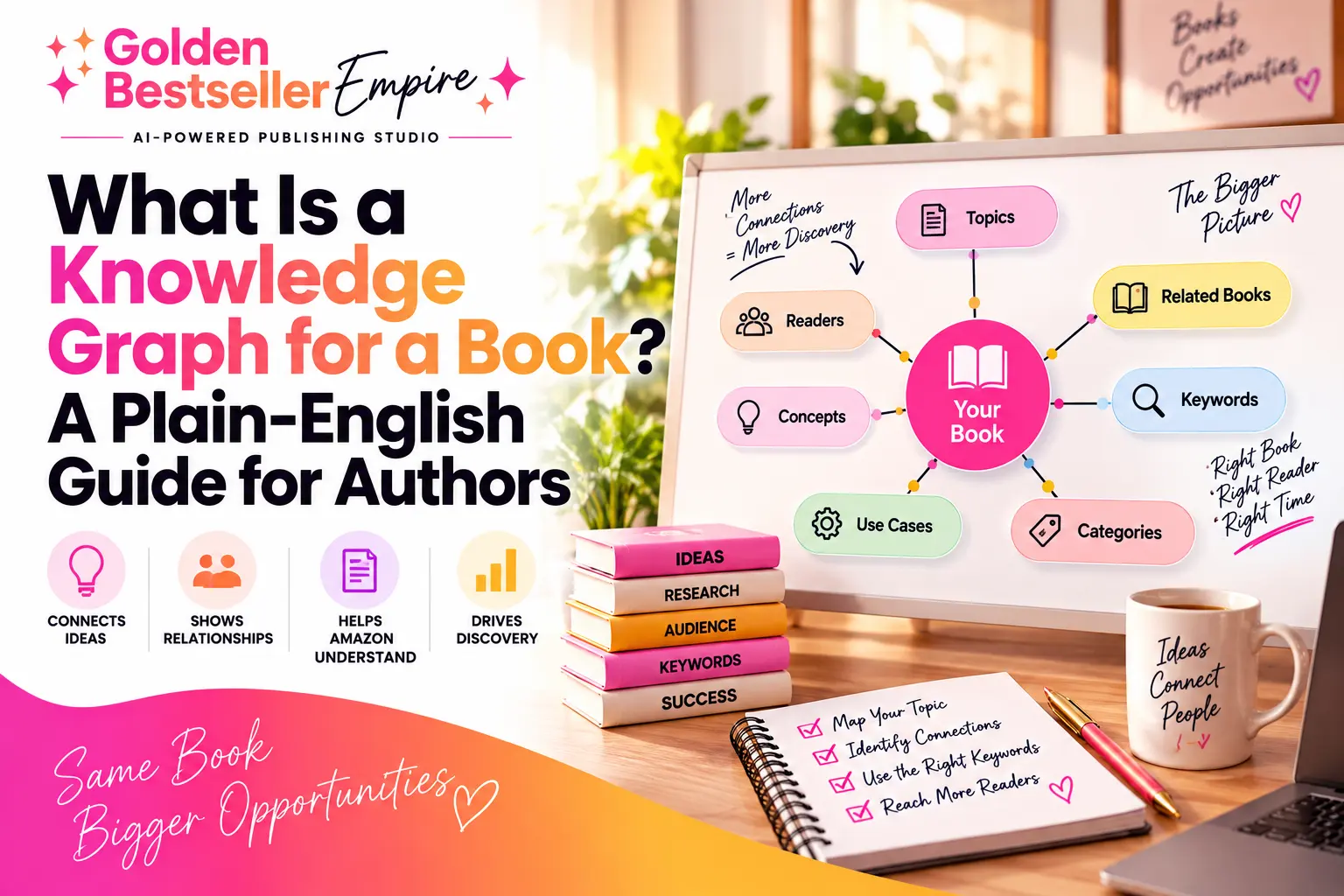
Definition
Things joined by named connections
Core Node
Reader + Gap → Transformation, in 3 to 5 words
18 Connections
15 from Amazon's COSMO paper + Author, Series, Format
KDP Says
"we use the actual words that match inside the book"

By Gundi Gabrielle
12 min read
Knowledge graph... sounds super techy, right?
It isn't. If you've ever said "this book is for tired working moms who feel guilty at night," you've already done the hard part. A knowledge graph is just that kind of answer, written down in a neat map that Amazon's computers can read.
I'll show you what one is, what goes in a book's graph and how to build yours. This post is part of my Amazon KDP algorithm guide.
What is a knowledge graph?
A knowledge graph is a map of things (called nodes) joined by named connections (called edges), like "this product is used by this kind of person."
Each fact has three parts: a thing, how it connects, and another thing. Amazon's own example: slip-resistant shoes, linked by a "used for audience" connection to pregnant women. Amazon Science says the graph can use the used_for_audience relationship to link slip-resistant shoes and pregnant women.
Stack up millions of those and you have a giant map. And the names on the connections are the whole point. They tell the computer why two things belong together, not just that they showed up in the same sentence.
👑 Want a map of your own book? Golden Bestseller Empire builds yours from your answers. → See how
Does Amazon really use knowledge graphs?
Yes. Amazon built a huge one called COSMO, which is its way of figuring out what a shopper actually wants when they type something in.
Here's why they bothered. The COSMO paper says other shopping graphs hold lots of product facts, but "they fail to discover user intentions". In plain words: knowing a shoe is black and size 8 doesn't tell you why somebody buys it. So here's what COSMO's graph looks like:
- 6.3 million nodes (the "things" in the web)
- 29 million edges (the connections between them)
- 15 relation types (the names on those connections)
- Built from real behavior: what shoppers search for and buy
Amazon says the same thing in its own news post: it's "not just about matching keywords anymore", it's about "understanding what customers are actually looking to buy."
One thing to keep straight: COSMO does not rank your book. It figures out what the shopper means and brings the right books to the table. Ranking is still sales, conversion and relevance. I explain the split in the COSMO guide.
Why does a knowledge graph matter for a self-published author?
A knowledge graph matters because it makes you think clearly about your reader before you write a single word of the listing. Most authors start with the title and hope for the best. That's backwards.
When you build your graph first, you get answers to the questions every buyer is silently asking:
- Is this book for someone like me?
- Will it fix the exact thing that's bugging me?
- When would I actually use it?
Your listing, your chapters and your ads then all give the same answers. A clear knowledge graph means every page of your book tells one story. And it costs you nothing but an afternoon of thinking.
What is a knowledge graph for a book?
A knowledge graph for a book is a map of one book: one big idea in the middle, joined to its reader, its result, its daily moments and its pairings.
The idea in the middle is your Core Node. Around it sit 18 connections in six groups. Here's the visual map from Golden Bestseller Empire:
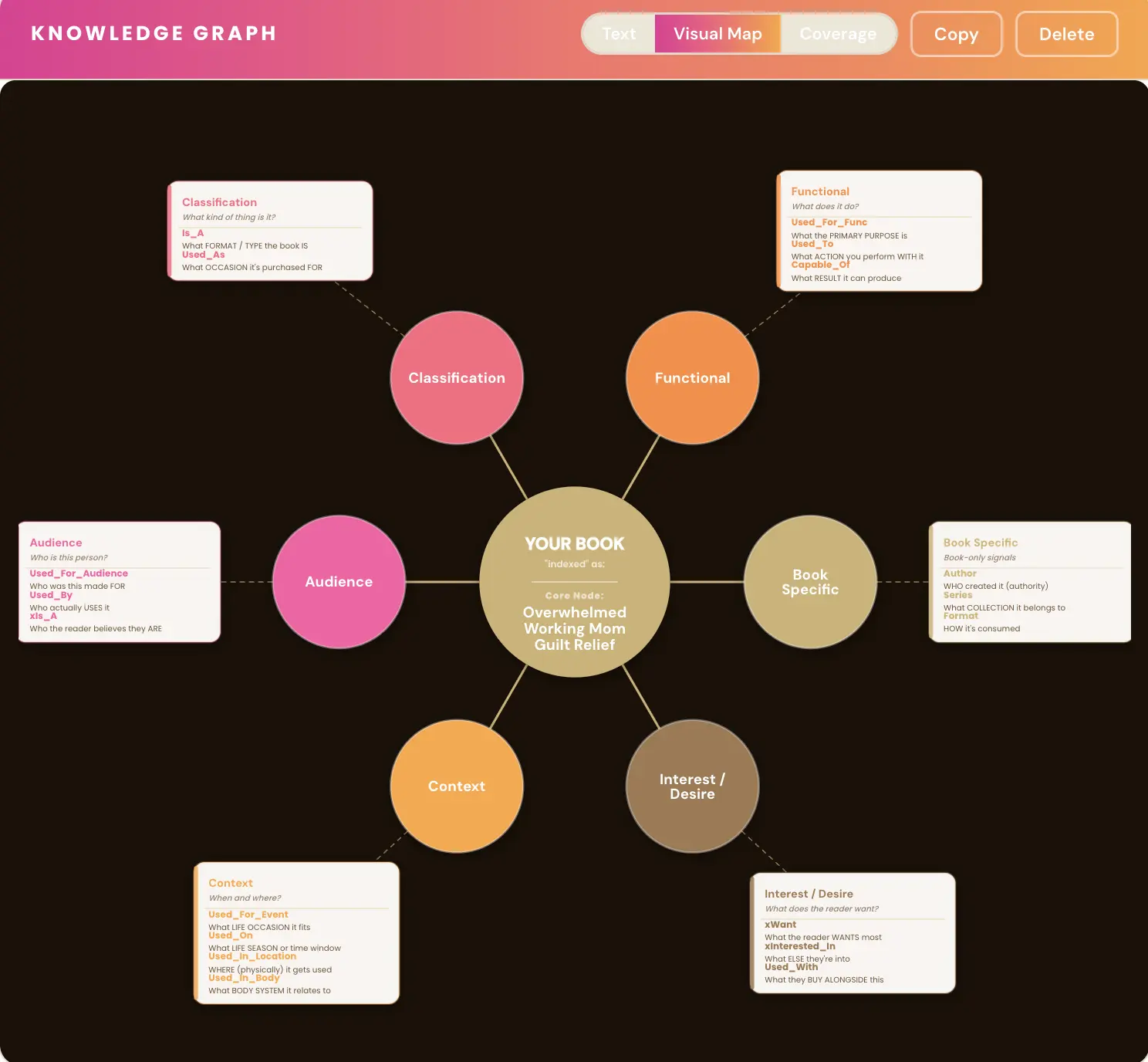
That's a sample book, not a real one. Pretty, isn't it... :)
Amazon already has its own map of how ideas connect. Your job is to hand it a clean, complete picture of your book so it can file it in the right spot.
👑 Not sure what your book's center is? Golden Bestseller Empire helps you find it. → Start here
What is a Core Node in a book's knowledge graph?
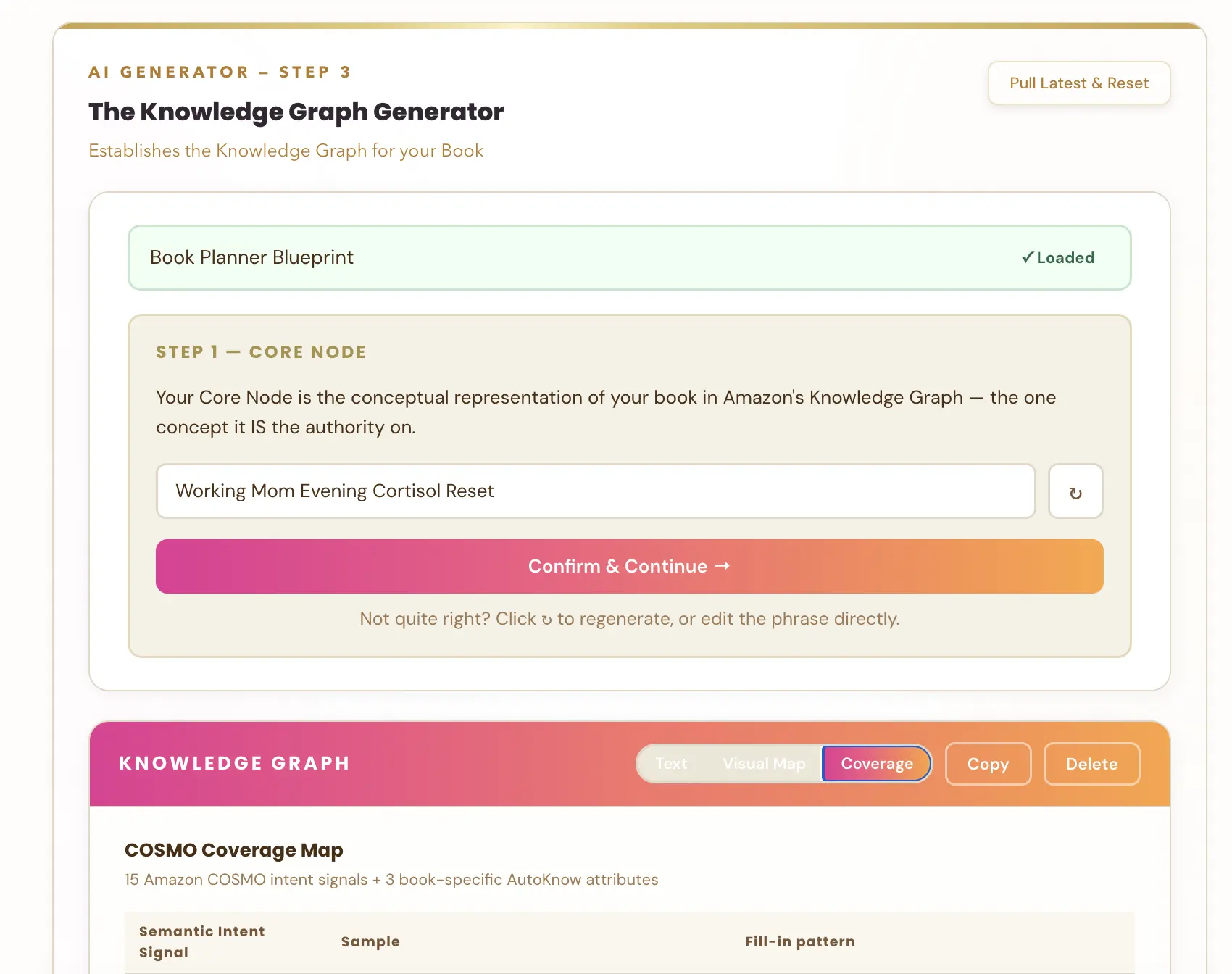
A Core Node is the one short phrase your book is the authority on. Think of it as your book's address in Amazon's map.
I teach a simple formula:
Reader + Primary Gap → Transformation = Core Node
Here it is with a real example:
Working Mom + Guilt → Reset = "Working Mom Guilt Reset"
Three to five words, and a stranger can picture who it's for.
Two things trip people up:
- It's not your title. "Working Mom Guilt Reset" is the territory your book owns. "How I Stopped Feeling Guilty at 6pm" is a title.
- The last word must fit the gap. Guilt plus "calm" doesn't match, because calm fixes anxiety, not guilt. Here's what fits:
| The gap | The transformation |
|---|---|
| --- | --- |
| Guilt | Relief, release, freedom |
| Exhaustion | Reset, renewal |
| Anxiety | Calm, ease |
| Overwhelm | Clarity, order |
And only one Core Node per book. Try to own three and Amazon can't tell what the book is. That's why a series works so well: Book 1 owns "Working Mom Guilt Reset," Book 2 owns a neighboring idea, and together they cover much more ground.
Why does one precise idea beat five vague ones in a knowledge graph?
Because Amazon trusts the most common reason people buy far more than the rare ones. In the COSMO paper, about 35% of search-to-purchase connections were the "typical" kind, the default reason a reader searches in a niche. Only about 9% of co-purchase connections were typical.
Here's what that means for you:
- Pick what most buyers in your niche really want.
- Cut the edge cases, even real ones. They blur the picture.
- Ask yourself: "Is this what the large majority of readers want, or what a few could want?"
A knowledge graph with one clear, typical idea in the middle is easy for Amazon to file. A knowledge graph that tries to say everything says nothing.
What are the six groups in a book's knowledge graph?
A book's knowledge graph has six groups: Audience, Classification, Functional, Context, Interest and Desire, and Book Specific. Together they hold 18 connections.
Each group answers a plain question:
- Audience (3): Who is this for? Their job, their life situation, and what they call this kind of book.
- Classification (2): What kind of book is it, and why do people buy it (gift, book club pick)?
- Functional (3): What does it do, what goal does it help with, and what change can it create?
- Context (4): When, where and in what moment is it used? Even the body side counts, like cortisol crashes.
- Interest and Desire (3): What does the reader want, what else are they into, and what do they use it with?
- Book Specific (3): The author, the series and the format.
Amazon's COSMO paper lists 15 of these connections. I add three for books: Author, Series and Format. That's the 18 I map in the course. I go through every one in the COSMO relations guide.
My favorite is the Context group. Naming the exact moment, like the 5pm arrival chaos or the school drop-off, gives Amazon one more door into your book.
What do concept node, LSI term and intent string mean?
They're three ways of saying the same idea. A concept node is the idea itself, an LSI term is how you write it, and an intent string is how your reader asks for it.
Say the idea is mom guilt.
- Concept node: Mom Guilt, the idea Amazon already knows.
- LSI term: "mom guilt," "guilt spiral," "evening guilt." (LSI just means the related phrases you use in your text.)
- Intent string: "why do I feel so guilty after work?"
Same idea, three costumes. Your graph covers all three, so what you write matches what readers type or say.
Notice what's happening here. When your listing says "mom guilt" and "mental load," Amazon isn't counting keywords. It's recognizing ideas it already has on its map.
👑 Want all three filled in for you? Golden Bestseller Empire maps every node. → See the generator
What does a finished knowledge graph look like?
A finished graph has a plain answer in every group, and every answer points back at the same Core Node. Here's a sample:
| Group | Example |
|---|---|
| --- | --- |
| Core Node | Working Mom Guilt Reset |
| Audience | Burned-out working moms who feel guilty at night |
| Classification | Self-help guide, a nice gift for a new mom |
| Functional | Calms the nervous system, builds an evening wind-down |
| Context | The 5pm arrival chaos, bedtime, the bedroom |
| Interest and Desire | Wants to stop snapping at the kids |
| Book Specific | By a burnout coach, book 1 in a series, Kindle and paperback |
No magic. It's clear thinking, organized. You can see it in the app as text, as the visual map or as a coverage table.
Does Amazon read the words inside my book?
Yes. KDP's own Read Sample page says: "When customers search for books on Amazon.com, we use the actual words that match inside the book".
So your graph isn't only for the listing. The introduction, the table of contents and every chapter subheader get read. The Look Inside window covers roughly the first 10% of the book. That's:
- Your table of contents
- Your introduction (the part that does the most work)
- The start of chapter 1
Each subheader can confirm another node, so I teach 4 to 6 per chapter, written as the reader's real situation, not a dull label.
How do you build a knowledge graph for your book?
You build one by answering questions about your reader and result, naming your Core Node, then filling in each group in plain words.
- Pick one reader. Who are they and what's their biggest struggle?
- Name the change. What can they do after reading?
- Write your Core Node. Reader + Gap → Transformation.
- Add 5 to 7 side themes. These are the neighboring ideas your book also covers.
- Fill in the six groups. Two or three plain phrases each.
- Add your author signals. Your story, your series, your formats.
- Cut the odd ones. Pick what most buyers in your niche really want, not every possible angle. One clear idea beats five fuzzy ones.
You can do it on paper in an afternoon (just draw the Core Node in the middle with six lines out to the groups). Easy to leave gaps, though. That's why I built a generator.
👑 Skip the blank page. Golden Bestseller Empire asks the questions and builds the map. → See the generator
What mistakes should you avoid when you build a knowledge graph?
The biggest mistake is making the graph about you instead of your reader. Here are the ones I see most:
- Using your title as the Core Node. The Core Node is the territory, not the headline.
- Using fancy words. Write the way your reader talks. "Mom guilt" beats "maternal affective distress."
- Leaving whole groups empty. Even one plain phrase in each group helps.
- Owning too many ideas. One Core Node per book, remember.
- Never using the graph. It's not a school project. Use the same words in your description, your chapter subheaders and your ads.
Fix those five and your knowledge graph is already better than most.
What does a knowledge graph feed?
The graph feeds everything else on your listing and in your book. Everything uses the same words, so it all says the same thing.
Here's what comes from it:
- Your outline and chapter details
- Your title and subtitle
- Your book description
- Your A+ content
- Your backend keywords
- Your translations
- Your Amazon ads keywords
Even the "Customers Say" tags come from your listing copy, so clear copy plants them. And since Rufus became Alexa for Shopping on May 13, 2026 (you'll find it in the Amazon app menu, not the search bar), the plain, human wording in your listing is what that assistant has to work with. More on that in the Alexa for Shopping guide.
If you wonder how this differs from keywords, I cover that in knowledge graph vs. keywords.
How does Golden Bestseller Empire build it for you?
Golden Bestseller Empire is the only app with an AI generator that builds your knowledge graph with one click, straight from your own Book Planner blueprint. I don't know of another app that does this.
Here's how it works:
- You write the blueprint. You answer guided questions about your reader, their biggest gap, the change and your goals. Your answers, your words.
- You click Generate. The app builds all 18 connections from your blueprint, each in your reader's own words.
- You see it as a map. As text, as the visual map, or as a coverage table.
- That one graph builds the rest: your outline, description, A+ content, backend keywords, translations and ads keywords.
It's AI-assisted, not AI-written. You write or dictate the book yourself. The planning and publishing work is what gets so much easier.
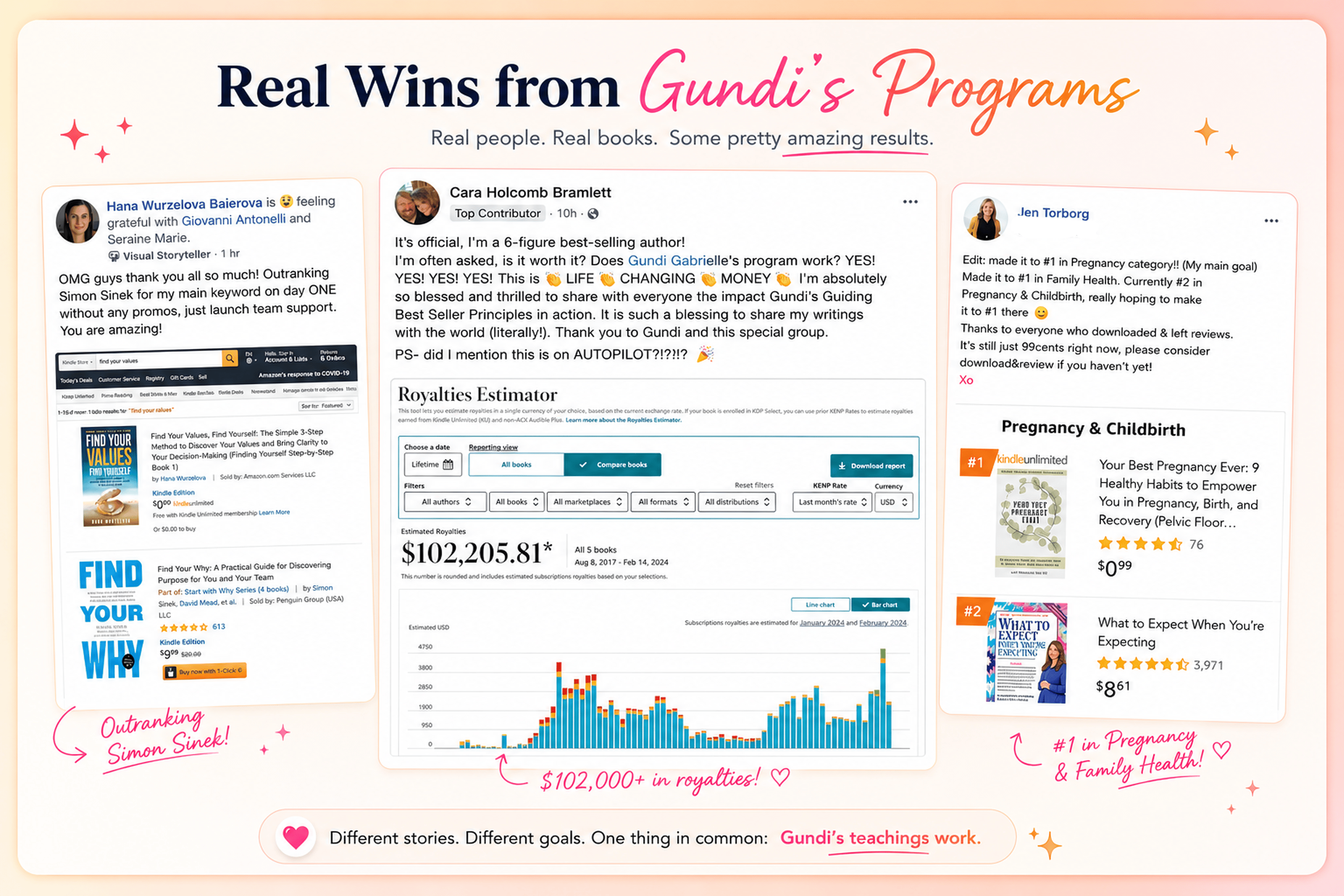
I used it to write and publish AI for Beginners. It was faster, easier, and it hit #1 within 3 days.
Related reading
Want to go deeper? These posts pair well with this one:
- Knowledge graph vs. keywords: how the two differ.
- COSMO relations explained for books: every connection, one by one.
- Amazon bookpage ready for AI shopping: get your page set up.
- KDP keywords: rules and limits: the seven keyword boxes.
What should you remember about a knowledge graph?
A knowledge graph is just your book explained clearly: who it's for, what it fixes and when they use it. Start with one reader, name one Core Node and fill in the six groups in plain words. Do that, and Amazon has a clean picture of your book, and so do your readers. That's the whole power of a knowledge graph.
Frequently Asked Questions
What is a knowledge graph?
A knowledge graph is a map of things joined by named connections, like a product that is used by a certain kind of person. The names on the connections tell a computer why two things belong together.
What is a knowledge graph for a book?
It's a map of one book, with one big idea in the middle joined to its reader, its result, its daily moments and its pairings. In my course it has 18 connections in six groups.
What is a Core Node?
A Core Node is the one short phrase your book is the authority on, built as Reader + Gap → Transformation. "Working Mom Guilt Reset" is an example. It's not your title.
Does Amazon use knowledge graphs?
Yes. Amazon's COSMO paper describes a knowledge graph with 6.3 million nodes and 29 million edges, built from what shoppers search for and buy. COSMO maps what a shopper means to the right ideas. Ranking is still done by Amazon's A9/A10 algorithm.
How many connections does a book's knowledge graph have?
18. Amazon's COSMO paper lists 15, and I add three for books: Author, Series and Format. They sit in six groups: Audience, Classification, Functional, Context, Interest and Desire, and Book Specific.
Do I need software to build a knowledge graph?
No. Draw your Core Node in the middle of a page, add six lines out to the groups, and write two or three plain phrases under each. Golden Bestseller Empire just does it faster and makes sure nothing gets skipped.
Sources & Citations
- COSMO: A Large-Scale E-commerce Common Sense Knowledge Generation and Serving System at Amazon (SIGMOD-Companion 2024)
- Amazon Science: Building commonsense knowledge graphs to aid product recommendation
- Amazon: How Amazon is using generative and agentic AI to transform shopping
- KDP Help: Read Sample (Look Inside the Book)
This page is maintained independently and is not affiliated with Amazon. Always double-check the latest numbers inside your own KDP account before making pricing decisions.
Found this useful? Get more of this site in your Google.
One tap adds us as a preferred source — Google then shows you our posts more often in Search, Top Stories, and AI Overviews.
Created By

Top 100 Business Author · Carnegie Hall Conductor · Founder of Golden Bestseller Empire
Hey, I'm Gundi, and for over a decade, I've helped thousands of everyday people turn what they know into a bestselling book.
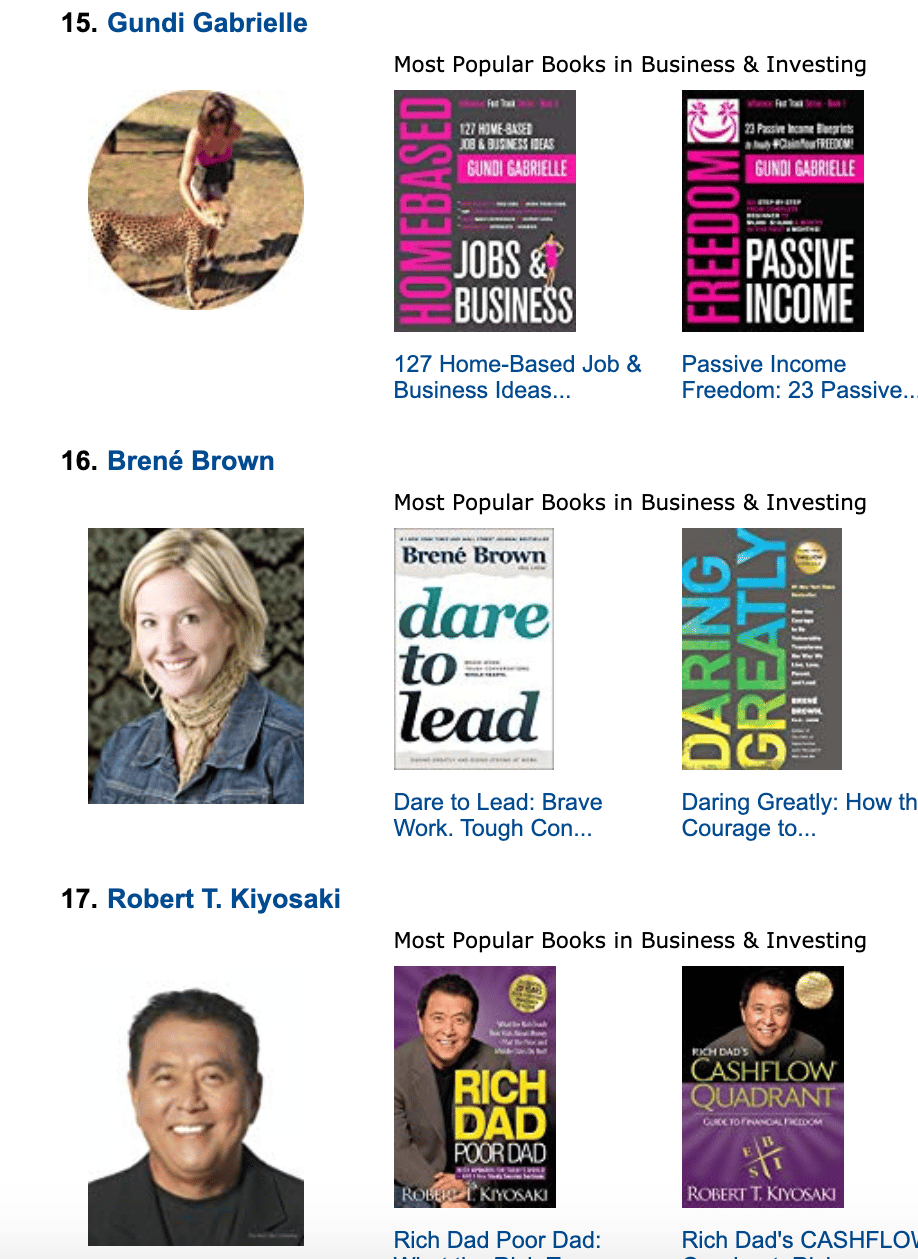
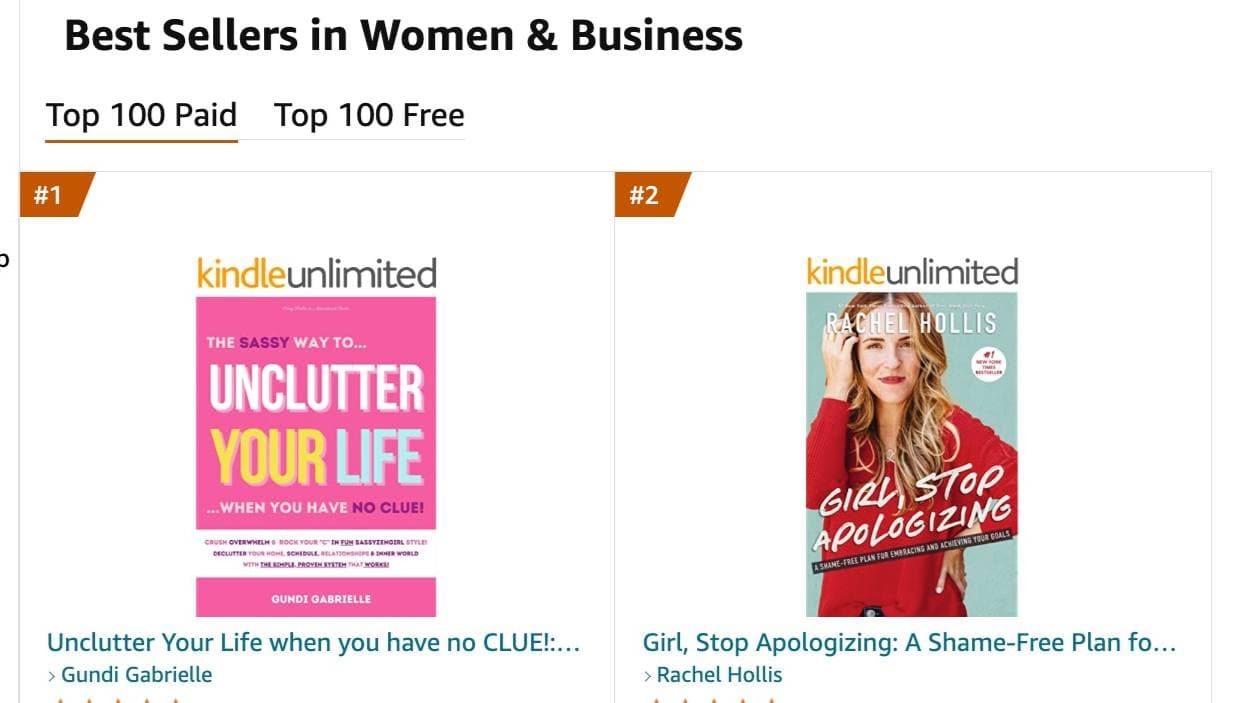
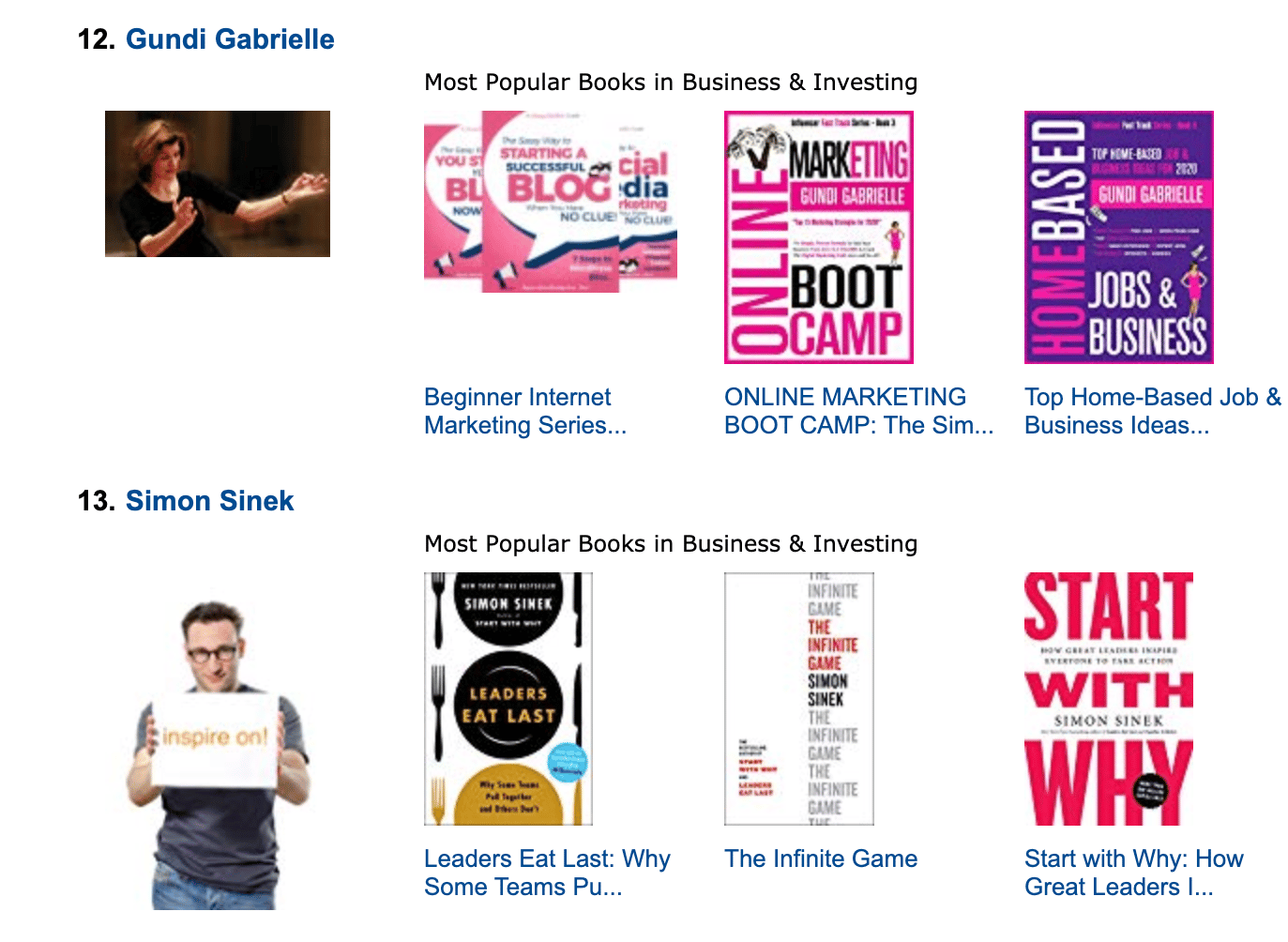
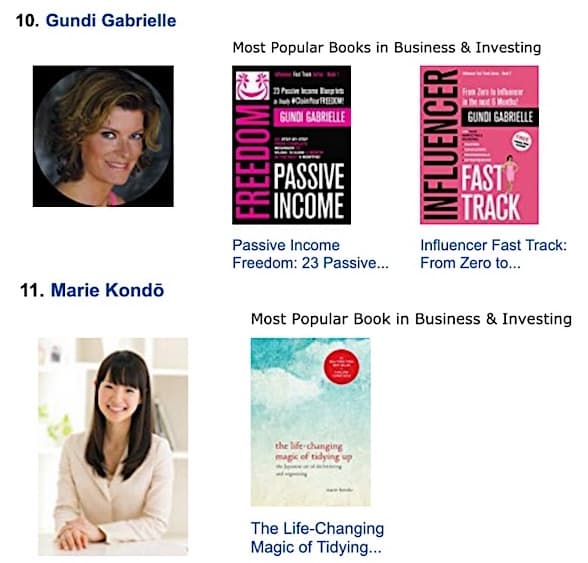
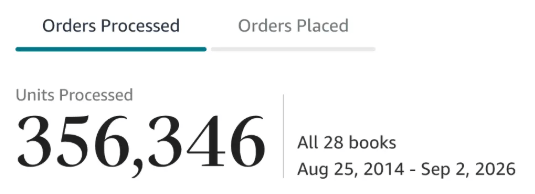
Along the way, I sold over 350,000 books, and was listed in Amazon's Top 100 Business Author Charts, ahead of authors like Simon Sinek, Brené Brown, Tim Ferriss, Robert Kiyosaki, or Brian Tracy.
No traditional publisher. No massive budget. Just understanding Amazon's algorithm and researching what readers actually want.
In my earlier years, I was a classical conductor & organist, touring the world, incl. Carnegie Hall & a performance for the Pope on St. Peter's Square.
These days, I love traveling as a Digital Nomad and orchestrating busy AI Agents 😎. Out of that came Golden Bestseller Empire — a complete AI-Powered Book Publishing Studio now helping authors around the world.
Can't wait to see you inside & help you publish your dream:
Featured In:
More on the Amazon Book Algorithm
Amazon Algorithm
Amazon KDP Algorithm: How It Works in 2027 (Amazon's New AI Algorithm Explained)
How the Amazon KDP algorithm works in 2027: keywords and sales, COSMO, Alexa for Shopping, and how a knowledge graph gets your book found.
Amazon Algorithm
Amazon COSMO Algorithm: What It Is and How Authors Can Use It
The Amazon COSMO algorithm maps why people buy. Here is what it is, what Amazon's own paper shows, and how to use it for your book, in plain English.
Amazon Algorithm
Alexa for Shopping for Authors: What Changed and What to Do
Alexa for Shopping replaced Rufus on May 13, 2026. Here is how it works for books and exactly what to put in your listing so readers get pointed to you.
Amazon Algorithm
Amazon A10 Algorithm for Authors: How It Ranks Your Book
The Amazon A10 algorithm decides which book shows up first. Here is how it works, where COSMO fits in, and what to do about it.
Amazon Algorithm
Amazon Book Ranking Algorithm: What Really Moves Your Book Up
The Amazon book ranking algorithm in plain English: what KDP says counts, what Best Sellers Rank really measures, and what you can do about it.
Amazon Algorithm
Knowledge Graph vs Keywords: Why Keywords Alone Aren't Enough on Amazon Anymore
Knowledge graph vs keywords on Amazon, in plain English: what each one does, why Amazon says search is not just matching keywords anymore, and how to use both. The seven backend keywords are only a small help.
Amazon Algorithm
COSMO and Alexa for Shopping: How They Work Together
COSMO figures out what a shopper means. Alexa for Shopping talks to them about it. Here is how COSMO and Alexa for Shopping fit together, in plain English, and what to do as an author.
Amazon Algorithm
COSMO Relations for Books: All 15 Explained (Plus the 3 Extra Ones for Authors)
The 15 COSMO relations from Amazon's paper explain why people buy. Here is each one in plain words, with the paper's example and what it looks like for a book.
Amazon Book Pages
Is Your Amazon Book Page Ready for AI Shopping?
Amazon's shopping assistant now answers questions and compares products in the search bar. Here's what that means for your Amazon book page, and what to check.
Amazon Algorithm
AI-Generated Books and the Amazon Algorithm: Why Specific Beats Generic
AI-generated books can rank on Amazon but rarely sell. Here is what KDP makes you disclose, why generic books lose, and the AI-assisted way to publish.
Want a faster way to plan and price your next book?
Golden Bestseller Empire's AI publishing tools help with exactly this kind of decision.